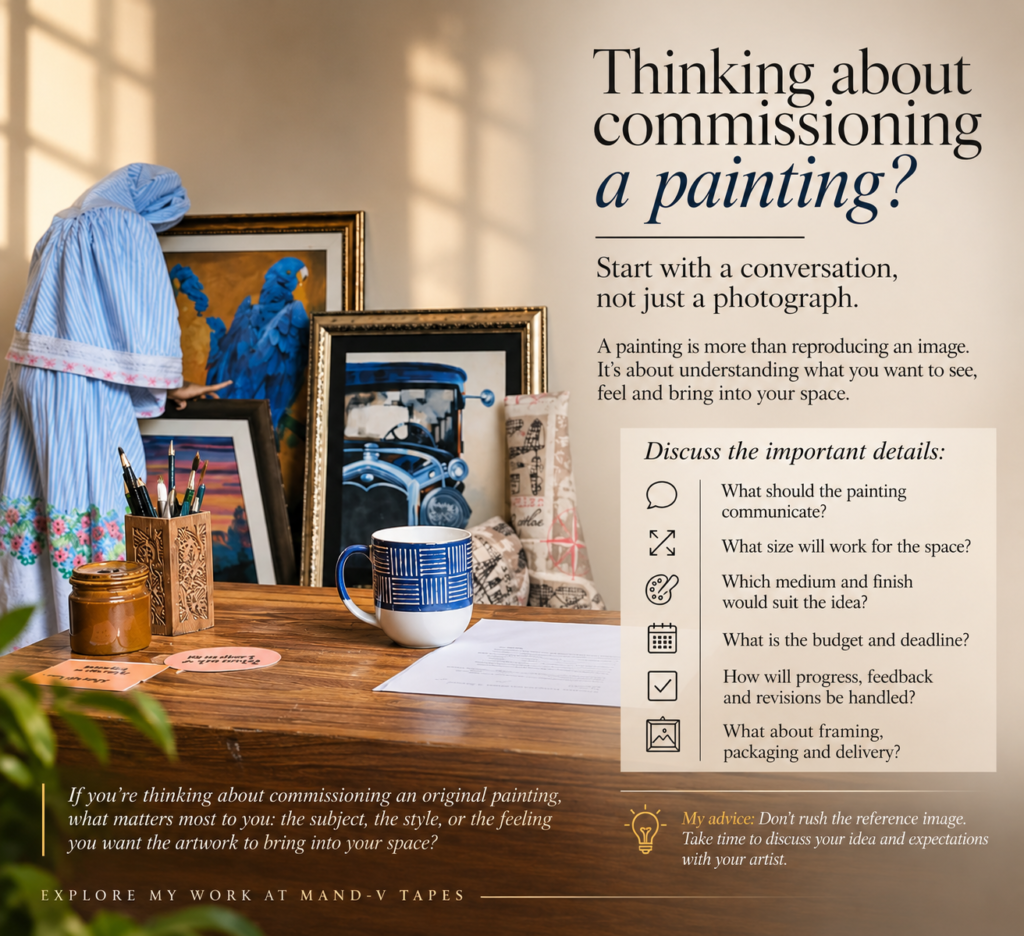
Thinking about commissioning a custom painting? Learn how to choose an artist, discuss your idea, agree on size and medium, and plan delivery.
How to commission a custom painting
Commission an original painting, custom oil painting, commissioned artwork, custom portrait painting, painting commission process
How to Commission a Custom Painting: A Complete Guide
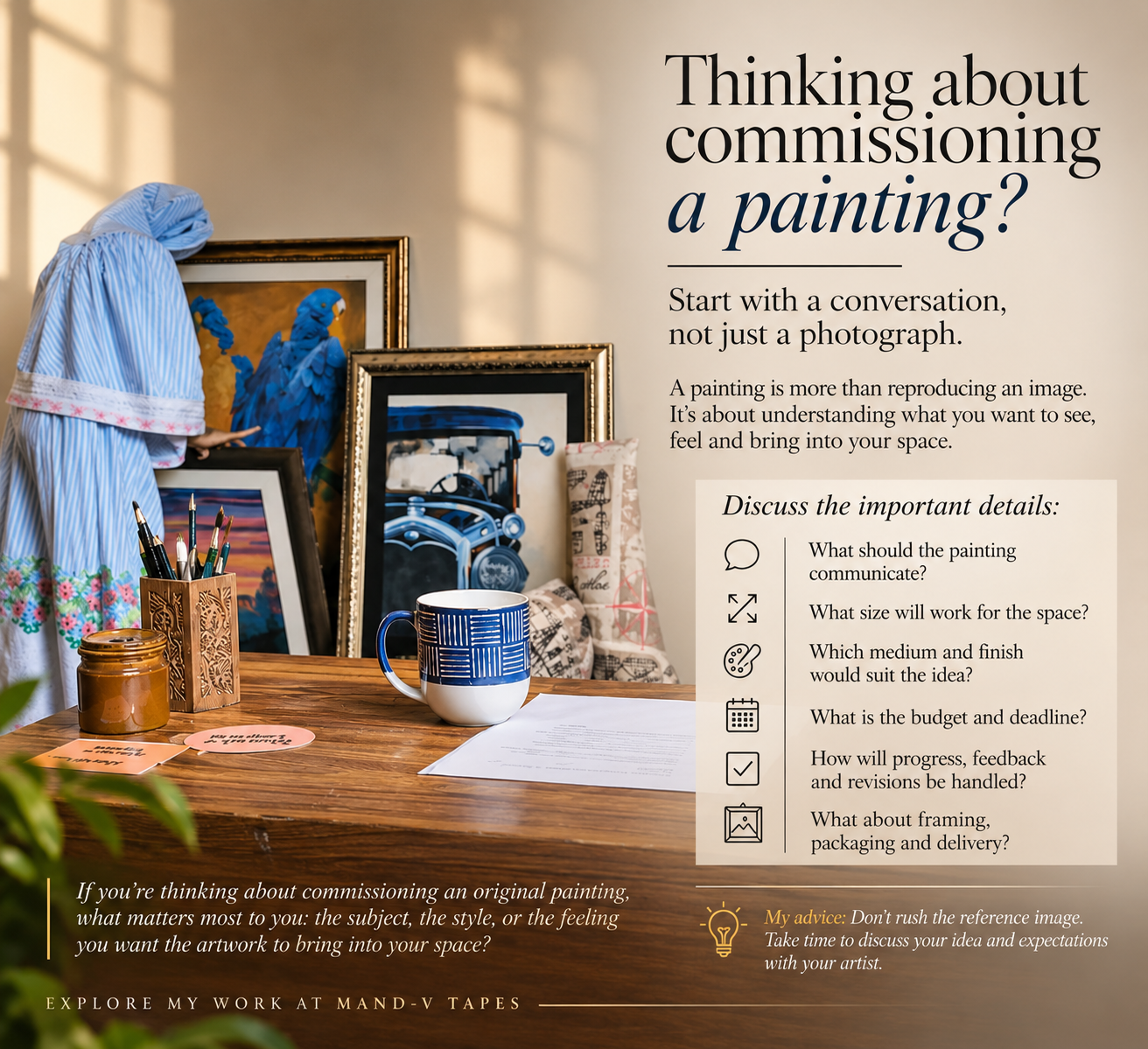
Commissioning a painting is different from buying an artwork that is already finished.
You may have a particular subject in mind, a space you want to fill, a photograph you would like interpreted as a painting, or an idea that is difficult to describe in words.
The process becomes easier when you and the artist establish a shared understanding before work begins.
Here are the main things to consider when commissioning a custom painting.
1. Begin with the idea
Start by explaining what you would like the painting to be about.
It could be a portrait, a meaningful place, a still life, a particular scene or a painting created for a specific room.
You do not need to arrive with every detail decided. A clear starting point gives the artist something to discuss with you.
If you have reference photographs, share them and explain what matters most about each one. Is it the subject, the lighting, the colours, the composition or the overall feeling?
References communicate your preferences, but the final painting should be discussed in terms of what the artist can realistically create.
2. Choose the size and medium
Think about where the painting will be displayed.
Measure the available wall space and consider how close people will stand to the artwork. A large painting may suit a prominent wall, while a smaller work may be more appropriate for a compact space.
The medium matters too.
Oil paint can be suitable for richly layered, detailed work, but it generally takes longer to dry. Acrylic paint dries faster and may be more appropriate when the schedule is tight.
The right choice depends on the desired result, the artist’s working process and the deadline.
3. Find an artist whose work you connect with
Look at the artist’s existing portfolio rather than relying only on a single image.
Consider their subject matter, handling of colour, treatment of light, level of detail and choice of medium.
If you want a realistic oil portrait, for example, look for relevant examples of that kind of work.
It is also important to discuss whether your requested subject fits the artist’s practice. An artist may be experienced in one medium or approach without offering every possible style.
4. Discuss the budget and timeline
Before confirming a commission, establish the price and what it includes.
Clarify the artwork’s size, medium, framing, packaging, delivery charges and any additional expenses. If the work is being shipped internationally, discuss delivery arrangements and any applicable import charges.
Agree on a realistic timeline. Drying, finishing, framing and shipping may all affect the completion date.
If the painting is intended as a gift or for a particular event, tell the artist early so the schedule can be assessed properly.
5. Agree on communication and changes
A commission is a collaborative process, but it helps to agree on expectations.
Ask how the artist will communicate progress and whether there will be opportunities to review the composition or other agreed details.
Discuss which changes are possible, at what stage they can be made and whether revisions affect the price or timeline.
This is particularly important once painting has progressed, because some changes require substantial additional work.
Written confirmation of the agreed details helps both parties understand the arrangement.
6. Ask about the finished artwork
Before the commission begins, clarify how the finished painting will be prepared for collection or delivery.
Ask about framing, protective packaging, care instructions and any certificate or documentation supplied with the work.
For an international shipment, confirm the delivery address, shipping method and responsibility for any customs requirements.
These practical details are part of commissioning artwork, not an afterthought.
Is a custom painting right for you?
A custom painting can be a meaningful way to acquire artwork that relates to your subject, space or personal preferences.
The best starting point is a conversation: explain your idea, explore the artist’s approach and agree on the details before work begins.
As a fine artist working across traditional media, including oil and acrylic painting, I know that the medium, composition, and timeline all influence how a painting is approached.
If you are considering commissioning artwork, explore the work available through Mand-V Tapes and get in touch to discuss your requirements.
A clear brief does not take the creativity out of a commission. It gives the creative process a stronger starting point.
