Learn how to draw objects in proportion using simple observation, measurement, and comparison exercises for more accurate beginner drawings.
How to draw objects in proportion
drawing proportions for beginners, observational drawing, measuring proportions in drawing, still life drawing tutorial
How to Draw Objects in Proportion: A Beginner’s Guide
Have you ever drawn an object that looked correct in your mind but somehow appeared too tall, too wide or slightly distorted on paper?
This is a common challenge for beginners. It is not always a problem with drawing technique. Often, the difficulty lies in observing and comparing proportions accurately.
Proportion describes the size of one part of an object in relation to another part, or the size of one object in relation to the objects around it.
Learning to compare these relationships can make your drawings more convincing.
Begin with simple objects
You do not need a complicated still life to practise proportion.
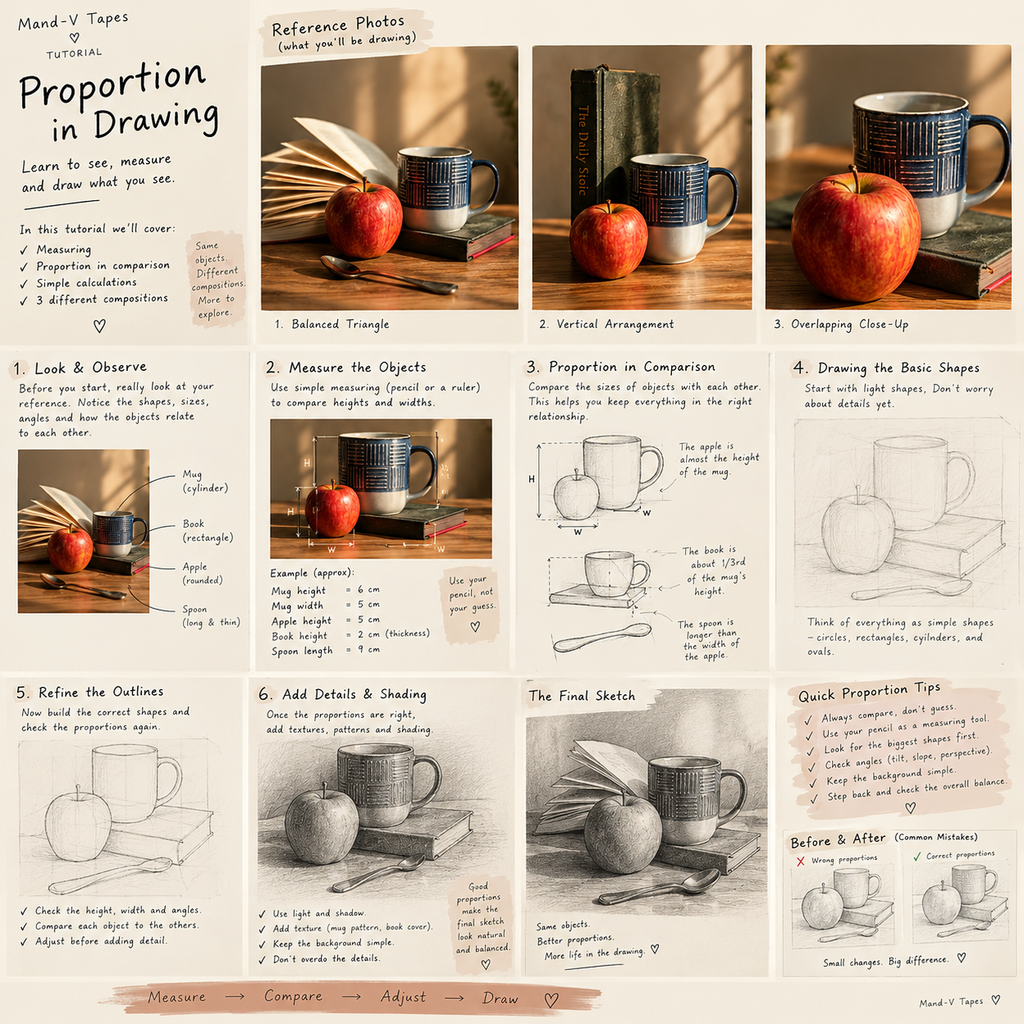
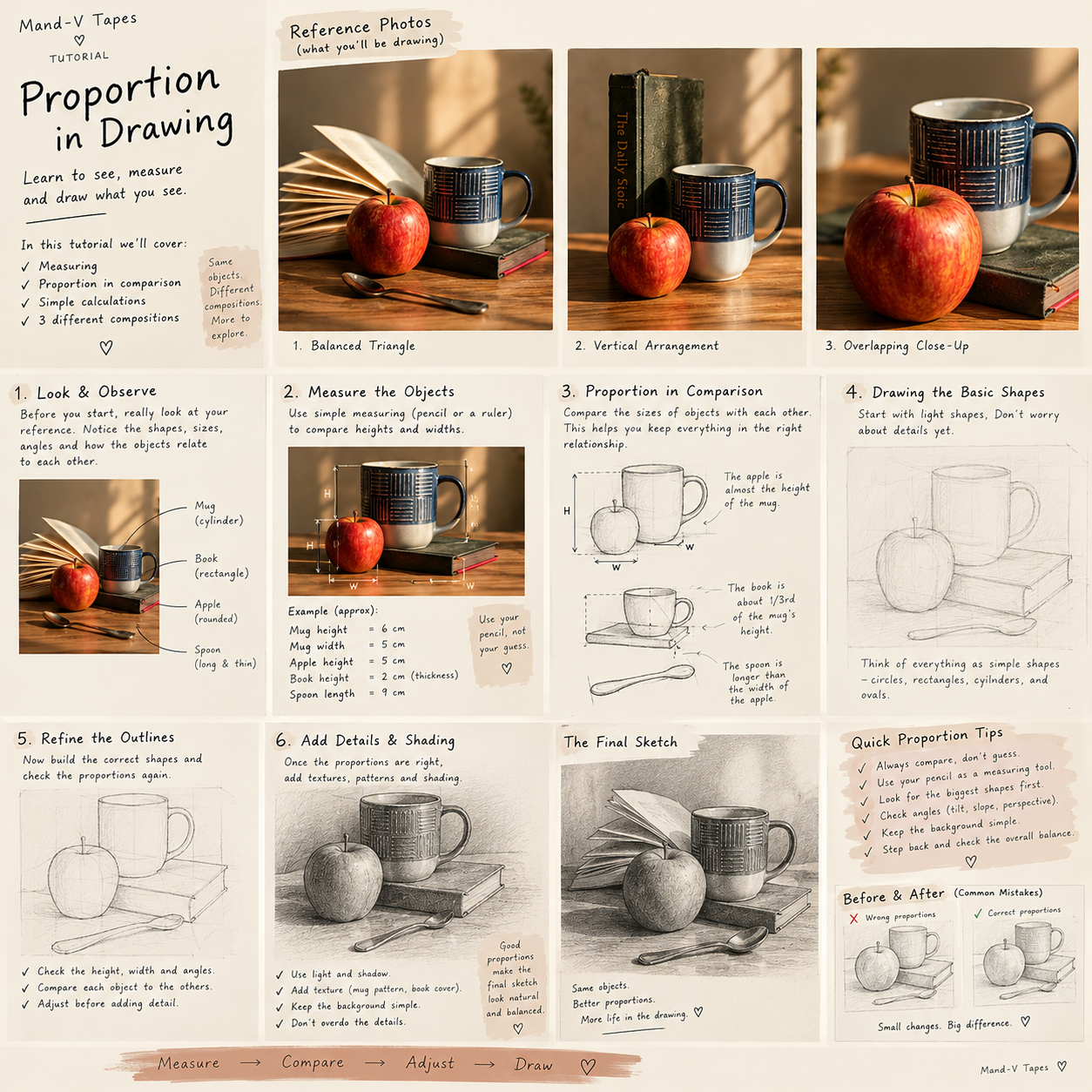
Start with an apple, a book and a coffee mug. Place them on a table where you can see their shapes clearly.
Before drawing details, observe the overall height and width of each object. Notice which object appears tallest, which is widest and how their sizes compare.
The aim is to understand the arrangement before concentrating on outlines, texture or shading.
Look at the whole shape first
A common beginner’s habit is to draw one small part carefully and then discover that the rest of the object does not fit.
Instead, begin with the overall shape.
For a book, lightly mark its general rectangular form. For a mug, establish the height and width of the body before drawing the handle. For an apple, observe its widest point and overall silhouette.
Keep these first marks light so you can adjust them.
Use comparison instead of guessing
Choose one measurement as your reference.
For example, look at the height of the mug and compare it with its width. Does the height appear greater than the width? By roughly how much?
Then compare the mug with the book beside it. How many mug-heights would fit alongside the book’s height?
You do not need perfect mathematical measurements. You are training yourself to notice relative sizes.
You can also use a pencil held at arm’s length to estimate height and width. Keep your viewing position consistent when comparing objects, and remember that perspective changes how shapes appear.
Check the spaces between objects
Proportion is not only about the objects themselves. The spaces around and between them also matter.
Look at the gap between the mug and the book. Compare the gap with the width of the mug or the length of the book.
These negative spaces can help you identify whether an object has been drawn too far to one side or is incorrectly positioned.
Sometimes the empty space is easier to judge than the object itself.
Compare before adding details
Once you have lightly sketched the main shapes, pause.
Compare your drawing with the arrangement in front of you. Is the mug too tall? Is the book too narrow? Is the apple placed too close to another object?
Correcting these relationships now is usually easier than trying to fix them after adding detailed shading.
Only move on when the overall arrangement feels reasonably accurate.
Practise observation, not perfection
Drawing in proportion develops through repeated observation. You will make mistakes, notice them and gradually become better at identifying what needs to change.
Try the same exercise with different objects. Draw a bottle beside a box, a shoe beside a book, or a cup beside a plate.
As you practise, focus on three things: the overall shape, the relationship between measurements and the spaces between objects.
At Mand-V Tapes, my art education work includes foundational drawing skills that help students build confidence through observation and practice.
Remember: a convincing drawing does not begin with perfect details. It begins with seeing the relationships correctly.
